
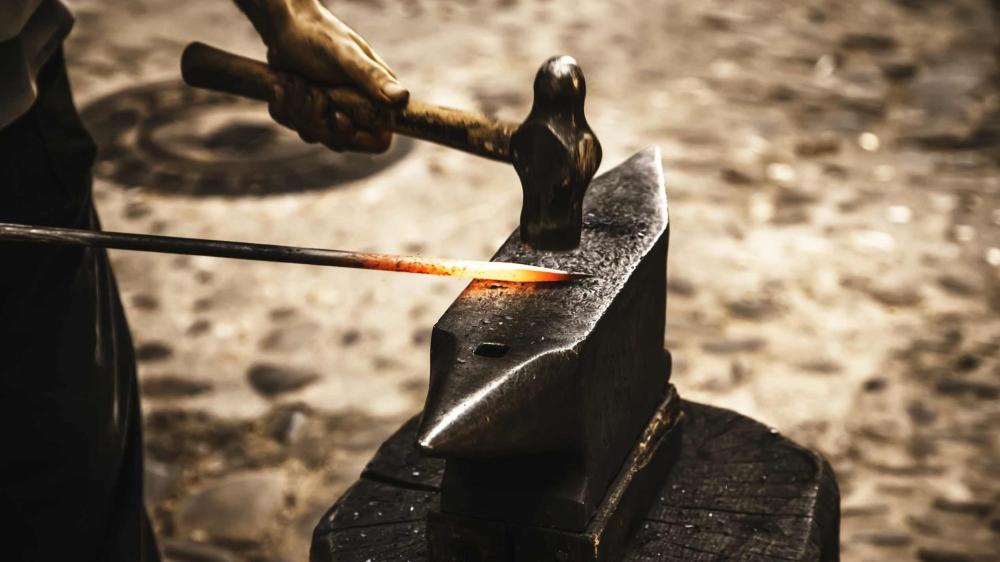
The foundation of sword making – what determines true strength?
Before choosing the type of steel, it is important to know that the true performance of a sword depends not only on the type of iron , but also on:
- Heat treatment is the most important factor; it determines the edge hardness and back flexibility.
- Differential hardening: makes the edge of the sword very hard while the back remains more flexible (as in a katana).
- Construction (Monosteel or Layered): Is the sword made from one piece of steel or multiple layers?
- Back thickness and blade geometry: determine cutting ability and bending resistance.
Therefore, the type of steel is important… but the method of manufacturing it is even more important.
1) Carbon Steel 1045
Information: AISI 10xx series low medium carbon steel (0.45% carbon), used in general industrial applications for ease of forming.
Performance: Flexible but its rigidity is limited.
Features: Economical price, easy to manufacture.
Important notes: Does not retain its sharpness for long, not recommended for very strong cutting.
Cost: Very low.
2) Carbon Steel 1060
Note: Medium carbon steel (0.60%) achieves a good balance between flexibility and hardness. It belongs to the AISI 10xx series and contains 0.60% carbon. It represents a point of equilibrium in carbon steel, allowing for good hardness without completely losing flexibility. It is commonly used in monosteel swords.
Performance: Suitable for average use.
Features: An excellent choice for beginners. A good balance between durability and sharpness.
Important notes: Requires rust protection, average sharpness retention.
Cost: Low.
To see more different models and designs, browse the collection of swords available at the Dice store.
3) Carbon Steel 1075
Note: Higher carbon steel (0.75%) provides better stiffness with acceptable ductility. AISI 10xx series steel with 0.75% carbon offers a stiffer structure that allows for finer edge angles, improving cutting performance.
Performance: Good cutting sharpness.
Features: Strong performance for the price.
Important notes: Requires regular maintenance to prevent corrosion. More prone to brittleness than 1060 if not properly treated.
Cost: Low.
4) Carbon Steel 1095
Note: High-carbon steel (0.95%) is renowned for its exceptional hardness after heat treatment. It is the highest grade in the AISI 10xx series (0.95% carbon). It can achieve very high hardness levels after heat treatment and is frequently used in differential hardening to produce extremely hard edges.
Performance: Very sharp.
Features: Excellent sharpness retention.
Important notes: Less flexible, may crack if misused, rusts quickly if not oiled due to the high carbon content.
Cost: Moderate.
5) High Carbon Tool Steel T10
Note: High-carbon tool steel. Classified as high-carbon tool steel , it is similar to 1095 steel but with added tungsten to improve its microstructure and corrosion resistance. It is popular in modern katana manufacturing.
Performance: Strong sharpness with improved flexibility.
Features: Ideal for katanas and hamons.
Important notes: Slightly higher price, requires careful heat treatment.
Cost: Medium to high.
Discover katanas inspired by the most famous One Piece characters by visiting the One Piece Swords section . ⚔️
6) Spring Steel 5160
Information: Alloy steel containing chromium and silicon is used in springs.
Performance: Very high flexibility and shock resistance.
Features: Withstands heavy use.
Important notes: Sharpness retention is lower than high-carbon steel.
Cost: Moderate.
7) European Spring Steel EN45
Note: European spring steel designed to withstand impacts. Consistent performance under repeated friction, therefore preferred in European training swords.
Performance: Flexible and robust.
Features: Good for sword training.
Important notes: Sharpness retention is moderate.
Cost: Moderate.
8) High Carbon Chromium Steel 12
Information: High-carbon and chromium steel is used in industrial bearings.
Performance: Very sharp.
Features: Retains sharpness for a long time.
Important notes: Less flexible than spring steel.
Cost: Medium to high.
9) L6 – Nickel Alloy Tool Steel L6
Note: Alloy steel contains nickel to increase durability and impact resistance.
Performance: Exceptional fracture resistance.
Features: Withstands extreme pressure.
Important notes: Complex heat treatment and higher cost.
Cost: High.
10) Damascus Steel
Note: This is not a specific industrial series like AISI or CPM, but rather a manufacturing technique that involves combining and folding multiple layers of different types of steel (often high-carbon steel with nickel-containing steel such as 15N20). These layers are repeatedly heated and hammered to form an interlocking layered structure, producing distinctive patterns and combining edge hardness with the flexibility of internal support.
Performance: Depends on the types of steel incorporated within it, but it generally provides a good balance between sharpness and durability.
Features: Unique engravings for each blade, luxurious appearance, ability to combine the properties of more than one type of steel into a single blade.
Important notes: Quality varies depending on the manufacturer and welding and folding technique. The goal may be more aesthetic than technical superiority. It requires rust prevention maintenance if it is high carbon.
Cost: High (luxury category, aesthetic and technical).
15) High Carbon High Chromium Tool Steel D2
Information: High chromium and carbon tool steel, semi-rust resistant, suitable for knives and heavy industries.
Performance: Excellent sharpness retention.
Features: Strong corrosion resistance.
Important notes: Less flexible, harder to sharpen.
Cost: Medium to high.
16) Stainless Steel 440C
Information: High-carbon stainless steel, famous for its high chromium content to improve rust resistance.
Performance: Good in humid environments.
Features: Excellent rust resistance.
Important notes: Not the best for heavy long swords.
Cost: Moderate.
16) Tamahagane Steel
Note: Traditional Japanese steel does not belong to modern industrial chains such as AISI or CPM. Instead, it is made using an ancient method in a Tatara furnace with iron sand. The pieces are sorted according to their carbon content, then folded and hammered many times to improve the metal's purity and carbon distribution—a fundamental technique in the making of historical katanas.
Performance: Provides an excellent balance between edge stiffness and body flexibility when manufactured using the traditional multi-layer method.
Features: Very high historical and cultural value, traditional layered structure that enhances durability, unique aesthetic resulting from hand folding.
Important notes: Quality depends on the blacksmith's skill, and is not necessarily technically superior to some modern steel.
Cost: Very high (traditional luxury category).